
Why capital Is flowing to bullion and silicon
With gold at $5,500, up 98%, and silver up 60%, investors pay premiums for scarcity. Why metals and semiconductors anchor the barbell strategy.

By Harsh Karamchandani · CFA Charterholder | Trading Operations & Product Strategist
28 January 2026 · 6 min read
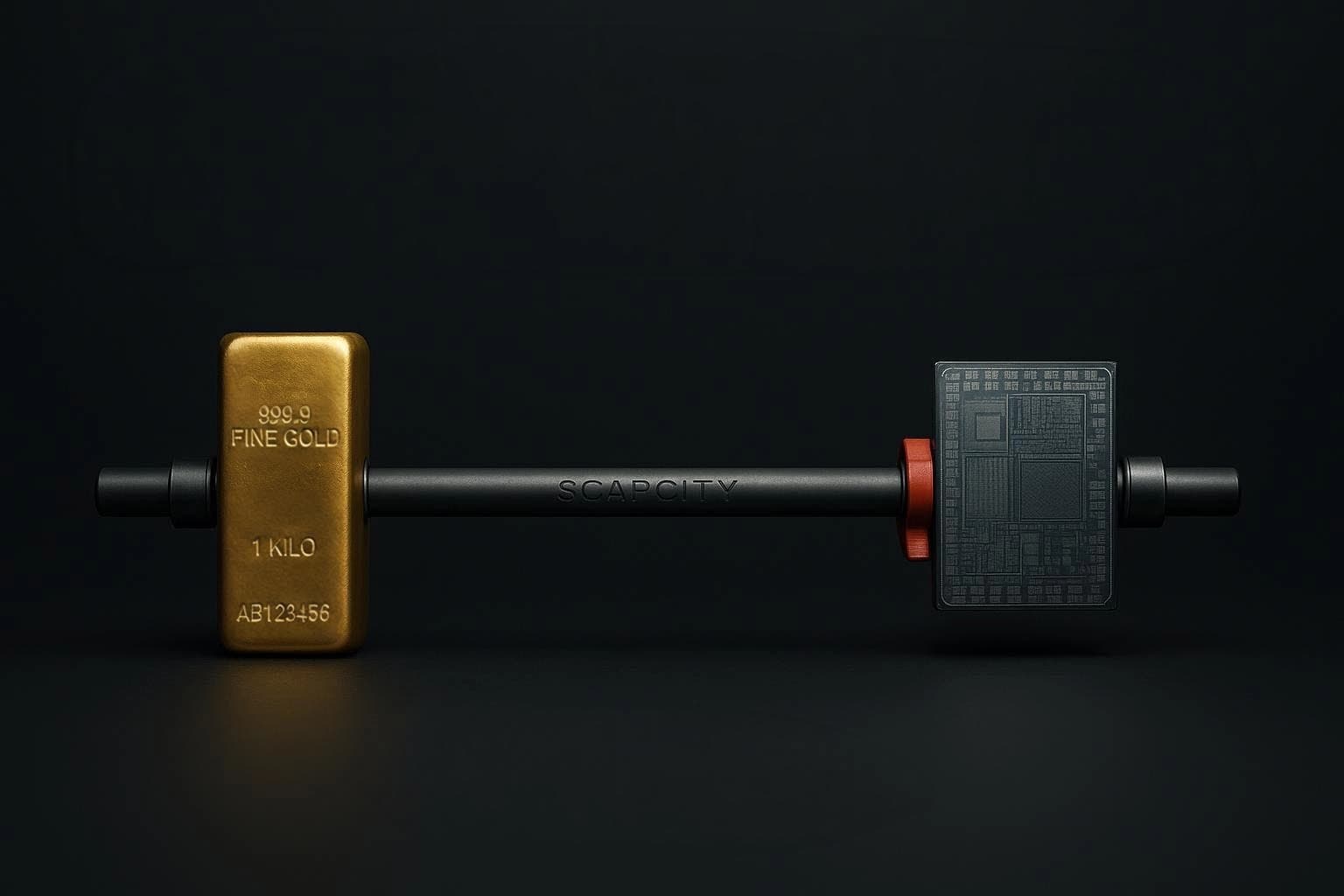
My core investment thesis for 2026 remains focused on a single theme: capital is flowing toward scarcity market analysis. In a market saturated with liquidity, investors are paying a massive premium for assets that are structurally difficult to produce. This "barbell" strategy balancing defensive barbell strategy real assets with offensive AI infrastructure is defining my portfolio’s performance.
Gold & Silver
The most significant trend of early 2026 is the historic divergence in precious metals.
Gold (XAUUSD) has officially touched the $5,500 mark. While it hasn't yet established a definitive floor at this level, the momentum is staggering: it is up 26.32% YTD (since Jan 1st) and has delivered a massive 98.47% return over the last 1 year.
This repricing is driven by a "Perfect Storm" of three factors:
- The geopolitical shock: The recent US intervention in Venezuela and the capture of Maduro has ignited a firestorm of uncertainty. When nations wobble, capital flees to safety, and right now, that safety is Gold.
- The global pivot: Central banks are cutting interest rates again to stimulate growth. This is critical because cash accounts now pay very little interest. In high-rate environments, you "lose" money by holding Gold because it yields nothing. But with rates slashing to near zero, that penalty is gone. There is no longer a cost to holding safety.
- The sovereign bid: Central banks themselves are buying record amounts to diversify their reserves away from the dollar.
Silver (XAGUSD) is the aggressive outlier. Trading at 116.55, it is already up 60% since the start of the year. The logic is simple: factories are devouring silver for solar panels and electronics faster than miners can dig it up.
In addition to spot prices, I hold SPDR Gold Trust (GLD) and iShares Silver Trust (SLV). These serve as my "vault" positions for core, long-term holdings that allows me to potentially capture this trend purely through exchange-traded funds without the daily management of spot trading.
AI chips
On the equity side, the semiconductor sector is firing on all cylinders, though selection is becoming critical.
Taiwan Semiconductor (TSM) is my portfolio anchor. As the manufacturer of over 90% of the world's advanced chips, TSM is the toll road for the entire AI economy. It’s not just about volume; it’s about complexity. With the shift to 2nm architecture, they are the only foundry with the yield rates to satisfy hyperscalers. Demand is rising exponentially, and there is simply no "Plan B" for the industry.
Micron Technology (MU) has been the top performer, up 370.04% over the last year.
- The Context: Why the massive run? We are in a memory "super-cycle." AI requires massive amounts of High Bandwidth Memory (HBM), and Micron is currently sold out for the next 12 months. They have pricing power we haven't seen in decades.
- The Warning: This stock is not for the faint of heart. Micron is a classic "boom and bust" cyclical play. While the boom is here, history tells us that if memory spot prices soften even slightly, this stock can drop 30-40% in weeks. I treat this as a high-risk, high-reward holding where I watch the exit door closely.
NVIDIA (NVDA) & Broadcom (AVGO) have both dipped recently, offering what I see as notable but not a recommendation. Broadcom has corrected from its recent high of 414, and Nvidia is taking a breather as well.
- The Logic: The recent sell-off is driven by fear that Big Tech is done spending on AI. The numbers say otherwise. Hyperscalers (like Meta and Microsoft) have actually increased their infrastructure budgets for 2026. NVIDIA is the brain of this new economy, and Broadcom is the nervous system that connects it all. As long as data centers are expanding, these two are non-negotiable. I view this dip as a "sentiment wash-out," but this is not investment advice, and outcomes remain uncertain.
Diversification
To balance out the high-octane chip stocks, holding Alphabet (GOOGL) and SPY to keep the portfolio grounded.
Alphabet (GOOGL) is my "Value Play." Google is trading at roughly 20x earnings, which is a steal compared to other tech giants trading at 30x or 40x.
- The "GARP" Thesis: This stands for "Growth at a Reasonable Price." In an expensive market, you rarely find a company growing this fast that is priced this low.
- Why the Discount? The market is still pricing Google like a boring "Utility" company (slow growth, reliable cash flow) because of last year's fear that AI would kill Search. That narrative is dead. With Gemini now fully monetized through higher ad rates in Search and massive Cloud adoption Google is growing like an AI startup but is priced like an old-school value stock. That mismatch offers a massive margin of safety.
SPY (S&P 500 ETF) is purely for diversification. If the tech sector corrects, SPY cushions the blow by providing exposure to financials, healthcare, and energy. It smooths out the equity curve so a volatile week in semiconductors doesn't derail the entire portfolio.
Watchlist
I am actively looking to rotate some profits into the following four assets, which are part of my current watchlist:
- Copper (XCUUSD): You cannot build AI data centers without copper cabling. Inventories are critically low, and I view this as the next "supply crunch" trade. If Silver is running because of industrial demand, Copper is structurally destined to follow.
- Platinum (XPTUSD): This is a value reversion trade. Platinum is historically cheap relative to gold. When the industrial cycle heats up, Platinum often outperforms, and right now it is priced for a recession that isn't happening.
- Bitcoin (BTCUSD): While Gold is breaking records, Bitcoin is consolidating. This divergence could be a possible discount entry, though this is not a recommendation, and the risks are significant. It remains the "digital" liquidity valve for the scarcity trade, and while prior consolidations have sometimes preceded large moves, that is no guarantee of future results.
- Microsoft (MSFT): I am looking here for stability. While Nvidia sells the shovels, Microsoft owns the mine. It is the safest way to play the software layer of AI, and its recurring revenue model adds a defensive layer to the portfolio that chip stocks lack.
The bottom line
The market is shifting away from rewarding speculation and toward rewarding tangible value. In this environment, I am allocating capital to the essential components of the global economy: the monetary metals that protect purchasing power and the semiconductor infrastructure that powers growth. It is a focus on necessity over complexity. This reflects my personal strategy and outlook.
(Disclosure: The author holds long positions in XAUUSD, XAGUSD, TSM, NVDA, MU, SPY, GOOGL, GLD, and SLV at the time of writing. This commentary is for informational purposes only and does not constitute investment advice.)