
I built an AI macro dashboard for FOMC week
The most divided FOMC in 33 years dropped its minutes. Here's the four-part AI workflow I built to read them before anyone else did.

By Priyanka Joshi · Vice President of Content & Marketing at Deriv
22 May 2026 · 7 min read

The most divided FOMC in 33 years just released its minutes. Three weeks from now, a new chair runs his first meeting. If you trade macro and you haven't tightened your process macro trading strategies between now and 17 June expert insights, you're going to spend the next three weeks reacting to headlines instead of reading them.
Right, let's get into it.
On 29 April, the Fed held rates at 3.50–3.75% on an 8-4 vote. That's the most dissents at a single meeting since October 1992. Governor Stephen Miran wanted a 25bp cut. Presidents Hammack, Logan and Kashkari held the rate but opposed the easing-bias language in the statement. Four dissents, three different reasons. The minutes, released on 20 May, confirmed the split: a majority flagged that some policy firming would likely become appropriate if inflation kept running persistently above 2%, while a minority is still looking for a cut once disinflation resumes.
That's the room Kevin Warsh walks into on 16-17 June as the 17th Fed Chair. Confirmed 13 May in a 54-45 Senate vote. First meeting in three weeks. Powell stays on as governor.
So the question isn't "what will the Fed do." The question is: between now and 17 June, what changes about what the market thinks the Fed will do, and which assets reprice first when it does.
The build, in full
I'll save you the suspense. This isn't a product. It's a stack of four things I run every morning, anchored on one principle: read the primary source before reading anyone's take on it.
Here's the actual setup, in order:
1. The Fed's own page. Pinned tab on the FOMC calendar and the April 28-29 minutes (Fed’s website has both HTML and PDF). This is the source. Everything else is commentary on it.
2. A focused calendar. Five events between now and 17 June: April PCE on 28 May, May NFP on 5 June, May CPI in mid-June, the FOMC decision on 17 June, and Warsh's first press conference the same day. Nothing else. Most macro calendars are too busy to be useful.
3. AI as a reading layer, not a thinking layer. I upload the full minutes PDF into Perplexity. Claude or ChatGPT work the same way; I happen to use Perplexity for the citation-linked output. For long files, the tool extracts the most relevant parts rather than reading every word, so I treat the summary as a starting point and check it against the actual document on anything that matters.
4. A watchlist that ties it back to price. Front-end Treasury yields, the dollar, gold, one equity index. If the policy story is real, the market is repricing it somewhere. The chart tells you which is somewhere first. That's it.
No custom GPT, no Zapier, no dashboard.
The work is in the prompts, not the tooling.
The three prompts I run every day
I run these every morning, in this order, in a single Perplexity thread with the FOMC minutes attached. You can copy them.
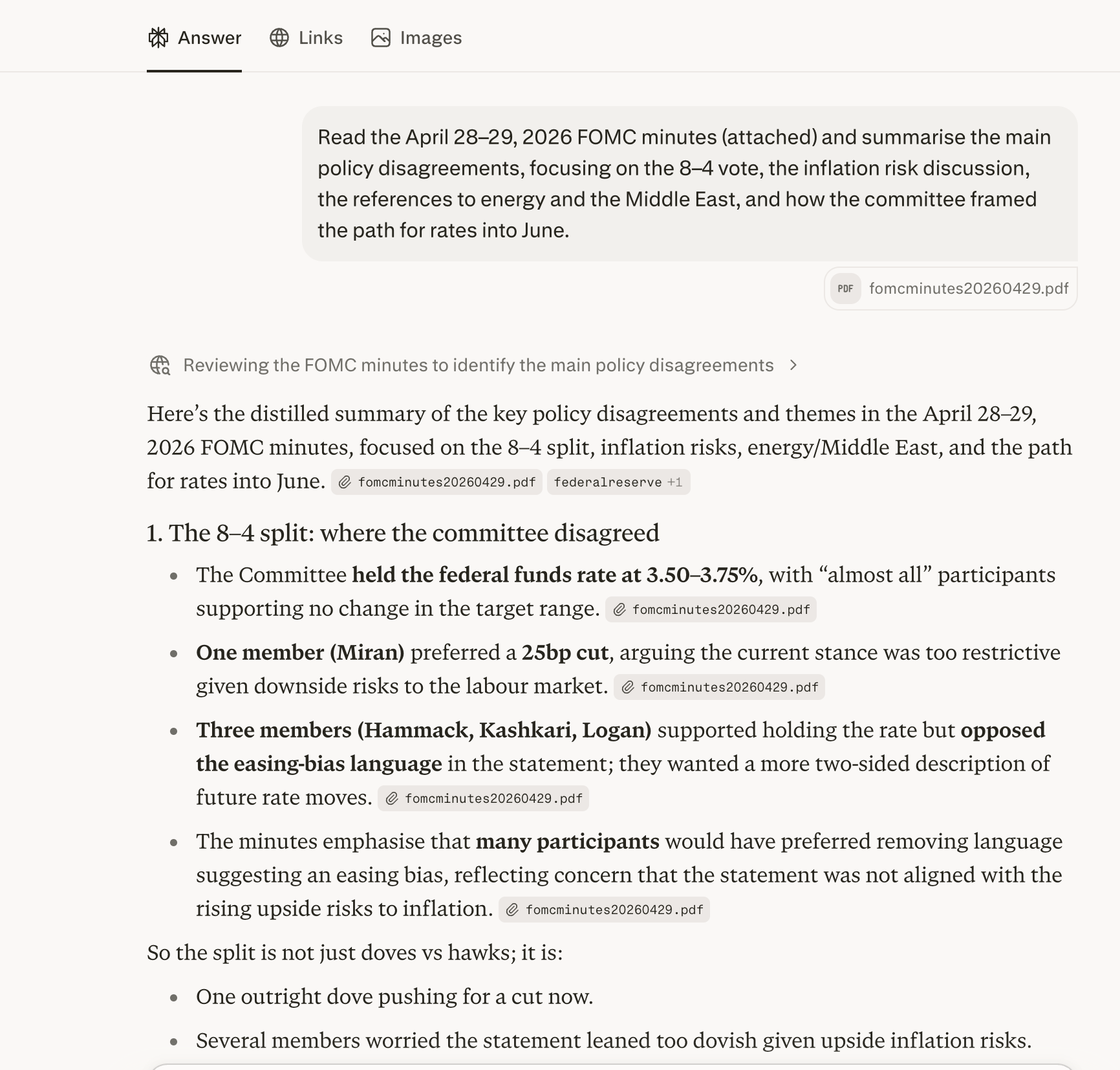
Prompt 1 — read the document properly:
"Read the attached ‘April 28-29, 2026 FOMC minutes.’ Summarise the main policy disagreements. Pay specific attention to the 8-4 vote, the language around inflation and energy prices, and references to the Middle East. Quote directly where the wording is doing real work."
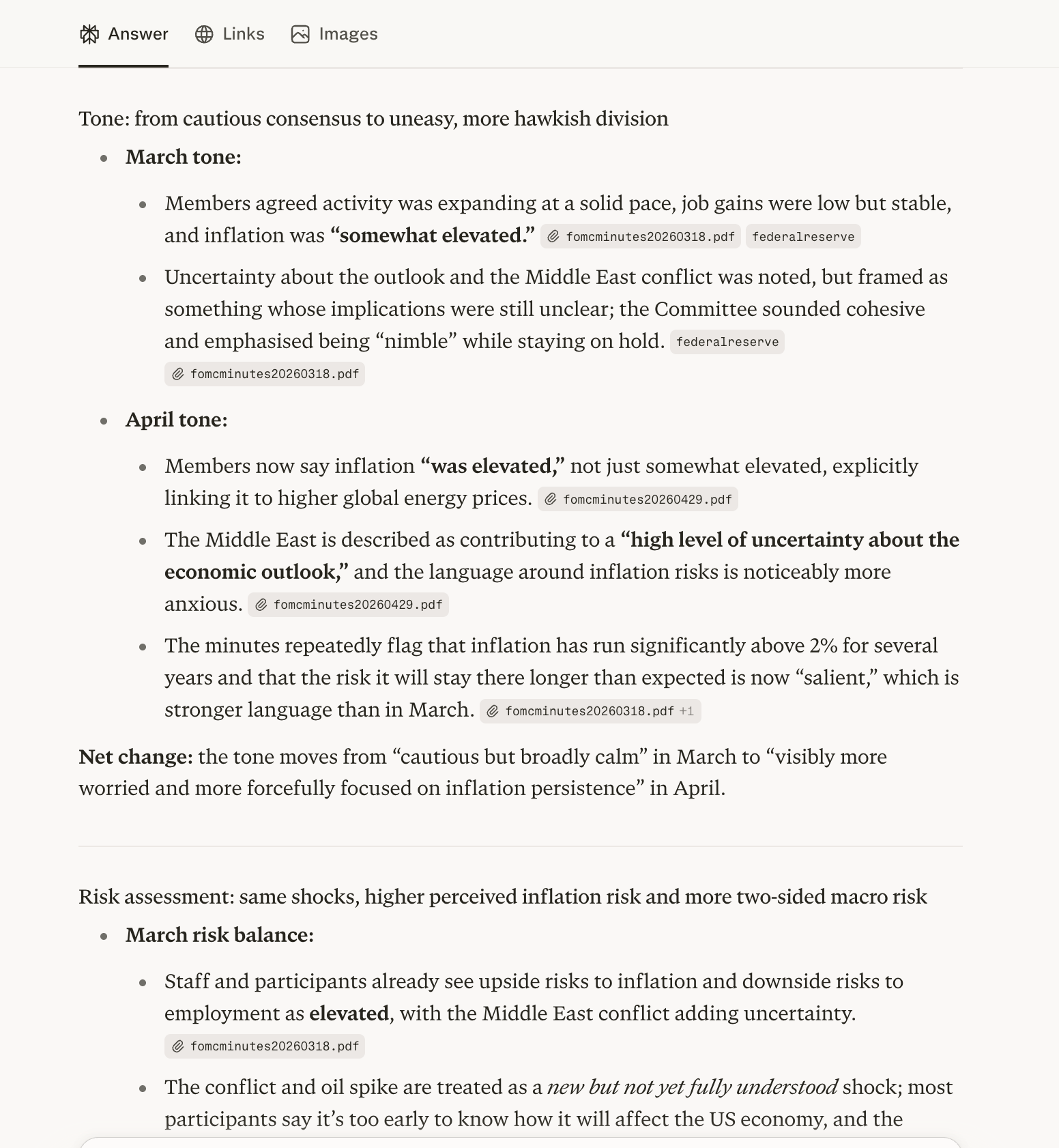
Prompt 2 — compare to last meeting:
"Compare the April minutes against the March 2026 FOMC statement and minutes. What changed in tone, in risk assessment, and in the balance of opinions on the next move?"
Prompt 3 — connect to the market:
"Based on the April minutes, which of these assets is most exposed into the June 16-17 meeting: front-end Treasury yields, the dollar, gold, or US equities? Give me three scenarios that would invalidate the current market consensus."
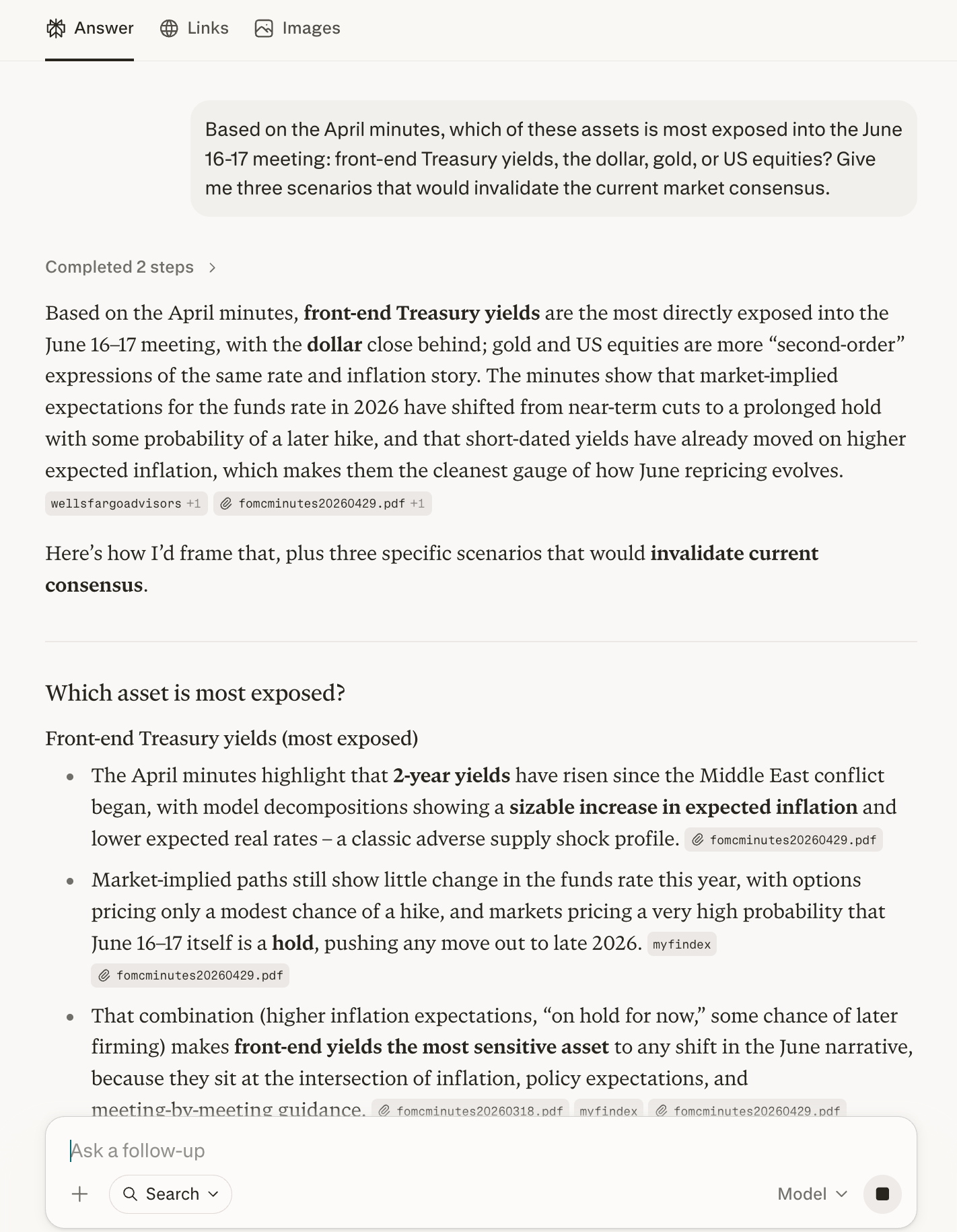
The third prompt is the one that matters. The first two help me see the consensus. The third stops me from joining it at the worst possible moment.
Why this is the honest workflow
A lot of "AI for trading" content overpromises. It implies the model knows something you don't, or that automation closes the gap between you and the market. It doesn't.
What it can do is read faster than you, summarise more sources than you can hold open, and surface what changed. That's a real benefit if you treat it as a research assistant and not an oracle. The edge is not just AI. The edge is reading the primary source while everyone else is reading takes on it, and using smart AI tools to read the document more carefully than you'd manage on your own at 7am.
I ran the three prompts on 20 May, the day the minutes dropped. I’ve saved the output. That's my dated baseline: what I thought mattered, what I expected the market to focus on, which scenarios I considered live going into 17 June. After the meeting, I'll compare what I thought would move against what actually moved.
That's the only honest way to get better at this. Almost nobody does it, because almost nobody writes anything down before the event. They just remember the bits they got right.
A workflow with a paper trail is harder to fool yourself with. That's worth more than any summary.
What I'm watching between now and 17 June
The April minutes laid out a clear menu.
Inflation is sticky, partly because of energy, partly because the Middle East developments added a fresh layer of uncertainty to the outlook. The committee is split between "we may need to firm" and "we may need to cut if the labour market weakens." Both views have data behind them. That's the messy bit.
There's a temptation to assume Warsh will keep things steady at his first meeting because that's what new chairs usually do. Maybe. MUFG has already pushed its first-cut expectations later in the year, partly because of him.
And yet the bigger risk at his first meeting isn't a surprise policy move. It's the language.
New chair, new press conference style, new emphasis on which mandate is in focus. Markets read tone shifts as policy shifts. That's where the volatility lives. A workflow doesn't predict tone. It helps you notice when the market is over-reacting to it.
In conclusion…
I didn’t intend this to be a forecasting system. Nor would it be your trading edge in the strict sense. Also it isn't a substitute for understanding the policy debate.
It's a way to stop the next three weeks of headlines from compounding into confusion.
The gap between traders who'll be prepared on 17 June and traders who'll be reacting on 17 June comes down to whether they used the next three weeks well. I'm using mine to read the room before the new chair steps into it.
If you want to copy the stack, it's right up there. Four tabs, three prompts, one principle: read the Fed before you read anyone reading the Fed. And save the output, so future-you can grade past-you on something other than vibes.