Gold has long been the “core” precious metal for many investors: a widely recognized store of value, a macro hedge macro hedge, and a portfolio stabilizer in uncertain times. But over the last year, silver has been attracting outsized attention—not because gold is losing its role, but because silver’s hybrid identity (precious metal and industrial input) has created a different set of catalysts.
Performance snapshot since start of 2025 (USD, per ounce)
Using the same start date for both metals highlights how differently they’ve moved:
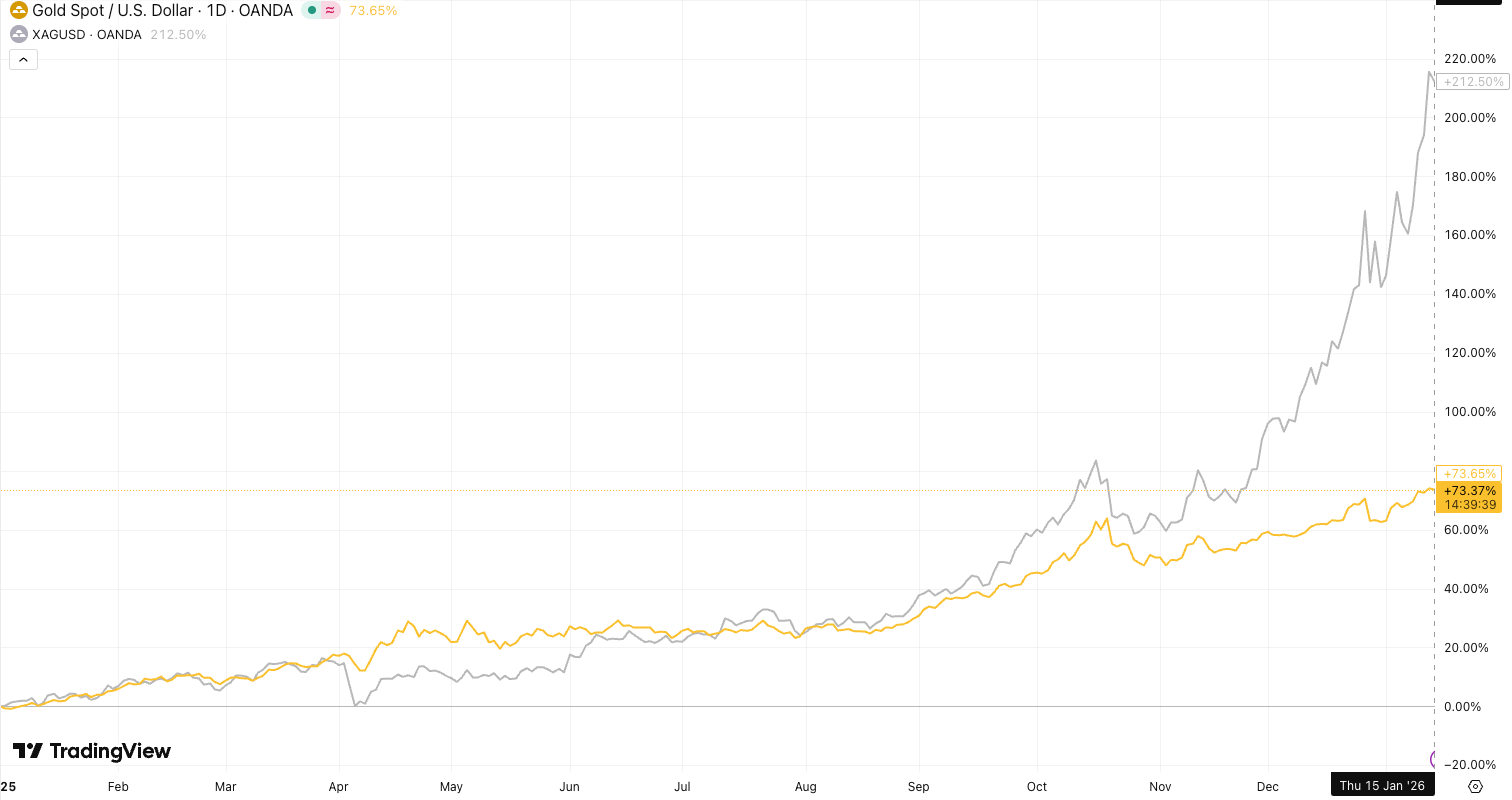
Silver: from $29.566 (2 Jan 2025) to $92.393 (15 Jan 2026) → +212.5%
Gold: from $2,658.23 (2 Jan 2025) to $4,616.04 (15 Jan 2026) → +73.65%
What this suggests: gold has risen strongly, but silver has outperformed in percentage terms, which naturally increases “traction” among traders looking for momentum and larger swings.
Why silver is getting more traction
Silver can behave like “gold with an engine”
Gold is primarily driven by macro factors: real yields, the dollar, central bank policy, risk sentiment, geopolitics. Silver responds to many of those plus demand tied to industry (and supply constraints), which can amplify moves.
Examples include solar photovoltaics, electronics, and electrical applications, which can make price moves more sensitive to manufacturing and clean-energy cycles. Industry bodies such as the Silver Institute regularly highlight how industrial demand represents a major share of overall silver usage, and how periods of tight physical availability can amplify volatility. (Source: The Silver Institute, World Silver Survey (annual))
That doesn’t make silver “better”—it makes it more reactive, especially in risk-on/risk-off transitions.
Higher volatility = more trading opportunity trading opportunity
Silver typically shows larger percentage moves than gold. In strong trends, that characteristic becomes a magnet for traders (especially short-term traders), because it can create more frequent opportunities across:
- breakouts and pullbacks,
- mean-reversion trades,
- event-driven spikes.
“Relative value” narratives spread fast: the Gold–Silver Ratio (GSR)
The Gold–Silver Ratio (GSR) is simply the gold price per ounce divided by the silver price per ounce. A rising GSR means gold is outperforming (or silver is lagging), while a falling GSR suggests silver is outperforming—often feeding “catch-up” narratives when investors rotate from gold into silver. That rotation can become self-reinforcing (flows → headlines → more flows). Because the ratio can swing sharply, traders often treat it as a sentiment/relative-strength indicator, not a timing tool on its own.
How traders approach gold & silver without overcomplicating it
Most active traders focus on three things:
- Trend + key levels (breakouts, retests, prior highs/lows)
- Macro catalysts (Fed minutes, CPI, jobs data, geopolitical headlines)
- Relative strength (watching silver’s momentum vs. gold when sentiment shifts)
If silver keeps pulling attention, it can become the “crowded trade” and the momentum trade—great for opportunity, but it also means risk management matters.
Summary
Gold can remain the strategic core metal—widely held, widely trusted, and often the first port of call in macro stress. Silver’s rising traction is more about its additional catalysts and bigger percentage moves, which can create more trading setups.