
Social media and Key Opinion Leaders now spread information faster and in greater volume than judgment. Within seconds of a sensational headline or a questionable chart, retail traders rush into the next big thing, often driven by fear of missing out. This reflexive behavior might offer a learning opportunity trading strategies at best; at worst, it can lead to financial ruin.
This is where structured thinking models such as second order thinking expert insights become indispensable. It is not just a tool for better decisions; it serves two critical purposes
- Offensive: spotting opportunities such as mispricings, often created by the herd-mentality, or first order reactions.
- Defensive: it forces one to pause, assess the market, potentially avoiding misjudgements and impulsiveness.
And what better illustration of this than the “AI Trade”?
“The AI Trade” isn't a strategy, it is an investment theme. On a high level, it is akin to the energy trade in winter. Search widow maker for a cautionary tale on why that analogy matters.
Crucially, an investment theme identifies a broad trend such as AI adoption is accelerating.
A trading or investing strategy answers how do I profit from it safely, consistently and with measurable risk. Note the difference between them.
Without that distinction, you are not executing a strategy, you are echoing a narrative.
Why “AI” alone is not enough to trade.
Many retail traders treat AI as a buy signal. They chase stocks that have not yet “mooned”, assuming these will rise simply because they are labeled AI related.
This trade may turn out in one of these scenarios
- The stock rises reinforcing the false belief that first order FOMO is a winning strategy.
- The stock trades sideways costing opportunity and tying capital.
- The stock drops despite the trader’s certainty it could not go down.
Let’s look deeper,
- Not all companies benefit meaningfully from AI. Even among those that do, the impact must be weighed against business cycles, capital expenditure plans, and competitive positioning.
- Price movements are often noisy, blurring the line between sentiment and fundamentals.
- In the short term, liquidity flows can overwhelm fundamentals. As Warren Buffett famously said, Be fearful when others are greedy and greedy when others are fearful.
- Regulation lags behind innovation. Depending on the context, new rules could either accelerate or stifle AI’s commercial viability.
How do we then apply second order thinking?
Before entering any AI trade, pause and ask: Is this price move driven by fundamentals or hype?
Even if fundamentals are strong, markets often swing into extreme euphoria or panic. As John Maynard Keynes warned, the market can stay irrational longer than you can stay solvent. Knowing where to position, not just whether to position, is critical.
Take C3.ai for example, an American tech company that specializes in enterprise artificial intelligence. On the surface, it seems like a clear AI beneficiary. But look at its price action over the past five years. What conclusions would you draw?

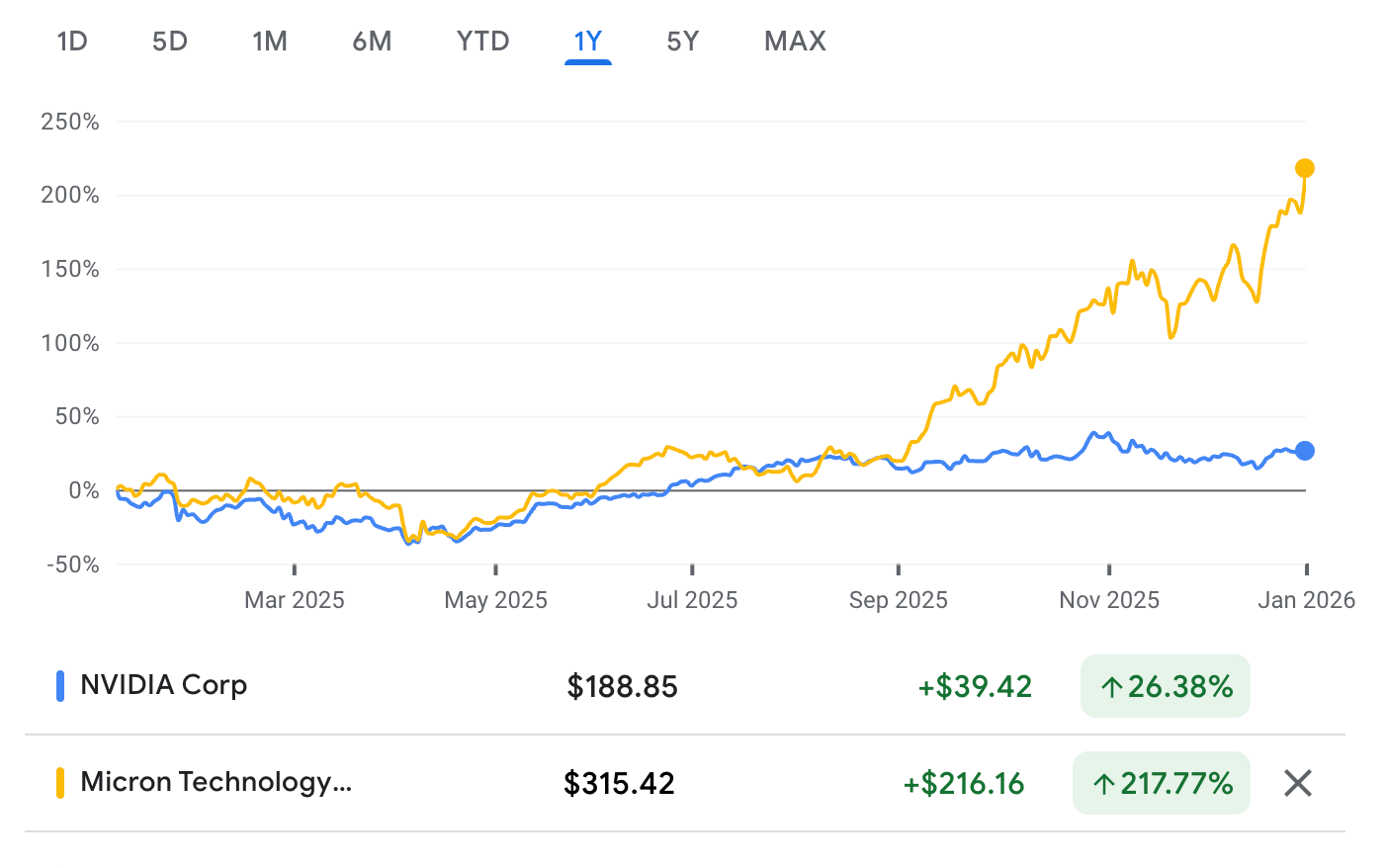
Now consider this, suppose you only began looking at the AI trade in 2025. NVIDIA might seem like the obvious pick, clear technology leadership essential to every major cloud provider and powering the AI wave. It is a safe choice .But was it the most profitable?
Applying second order thinking, NVIDIA’s stock surged 1322 percent over five years. What fundamentals would be needed to justify that valuation in the near term? How much higher would the valuation continue to surge?
Real world AI adoption requires more than just GPUs. Training models, generating tokens, and storing massive data logs all depend on high bandwidth memory. By late 2024, AI applications began permeating both enterprise and consumer markets triggering a surge in demand and a supply shortage for memory chips. In 2025, Micron, a leading memory manufacturer, outperformed NVIDIA by 9 times.
Yes, this is hindsight but the lesson stands. Second order thinking reveals hidden leverage points that first order narratives miss.
Going a step further,
First order reaction: AI is hot buy now before it goes higher.
Second order defense: C3.ai has minimal verifiable AI revenue, and widened CFD spreads high risk of reversal.
Second order offense: The broader picks and shovels of AI such as memory chips have not fully repriced. I will short C3.ai versus long Micron in a pair trade using CFD, as it offers both long and short entries easily.
Then ask: How much risk can my account handle? How should this translate into position sizing?
This simple open ended question can have a profound impact on your long term results.
Bottom Line
Second order thinking is about being slower and sharper.
The AI Trade will come and go. So will quantum computing, the metaverse, and the next viral narrative. But the traders and investors who consistently win are not those who chase the angle they are the ones who ask:
What happens next and what happens after that?