
How a leveraged holder turns from an asset's biggest buyer into its biggest risk
Strategy holds ~4% of all Bitcoin on borrowed money. Here's why markets price the threat of a forced sale long before any sale happens.
By the Deriv desk · 1 July 2026 · 4 min read

When one player owns a huge slice of an asset on borrowed money, the market starts pricing the threat of a forced sale long before any sale happens. That is the live story around Strategy, the company formerly called MicroStrategy, which holds roughly 4% of all Bitcoin. Its funding model is now the question hanging over the price.
Why a concentrated, leveraged holder becomes market overhang
Strategy financed much of its Bitcoin stack with preferred stock. That stock demands a fixed payment every year. The obligation runs to well over a billion dollars annually.
The software business behind it earns a fraction of that. So the dividends rely on the Bitcoin position staying strong and on capital markets staying open. When both of those wobble at once, the biggest buyer of an asset starts to look like its biggest source of selling pressure.
This is the durable mechanism. Leverage builds the position on the way up. The same leverage can threaten it on the way down. Traders see the maths and price the risk early.
Why a falling Bitcoin price strains the funding math
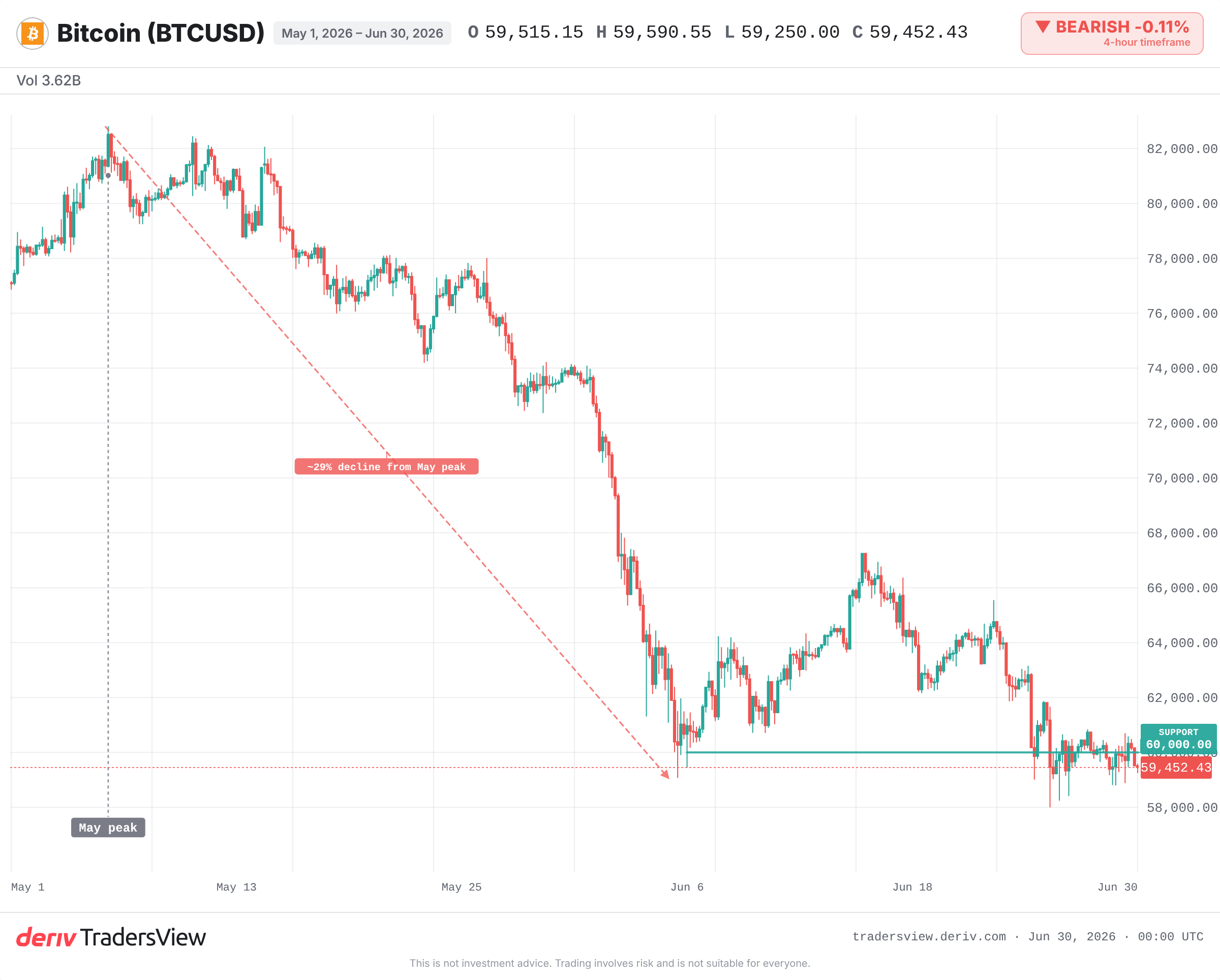
Bitcoin has fallen around a fifth since May. Strategy's preferred shares now trade well below their par value. Its common stock sits near a two-year low.
None of that forces a sale tomorrow. Cash reserves are reported to cover obligations for roughly ten to fourteen months. But the gap between fixed payments and operating income is the crack everyone is watching.
The criticism went public when Ripple chief executive Brad Garlinghouse called the preferred-stock model unsustainable financial engineering in a late-June interview. Then Grayscale's research head Zach Pandl suggested on June 28 that a transparent $3 billion Bitcoin sale could clear the uncertainty rather than spark panic.
Does a forced sale always crash the market?
No, and the history splits cleanly. The same setup has had two very different endings.
In 2022, Three Arrows Capital held a leveraged position funded by short-term obligations. As collateral values fell, it was forced to unwind. That selling cascaded through lenders and helped drag Bitcoin from the high-$30,000s toward the mid-teens.
That same December, MicroStrategy sold 704 Bitcoin for tax reasons, its first ever sale, then rebought more days later. The market shrugged, because the sale was small, transparent and explained. One unwind was panic. The other was housekeeping.
The bear case and what would have to break
The bearish read assumes forced selling is close. The evidence does not support imminent panic.
Strategy has a runway of months, not days. It has repeatedly raised fresh capital rather than sell coins. Grayscale's idea is advice, not an event. A controlled sale could even calm nerves, as it did in 2022.
The bear case turns right only if several things line up: Bitcoin keeps falling, capital markets close to Strategy, and dividend coverage breaks before it can refinance. So the real signal is not the size of any one drop. It is whether the funding doors stay open.
What to watch from here
- Whether Bitcoin holds or loses the contested ~$60,000 level.
- Any actual Bitcoin sale disclosure from Strategy beyond the small late-May trade.
- Preferred shares slipping further below par, or any missed or deferred dividend.
- Strategy's ability to raise new equity or preferred stock on acceptable terms.
- The common stock breaking below its two-year low.
The lesson outlasts this episode. A concentrated holder funded by promises it must keep paying changes the risk picture for everyone else. Crypto is volatile, and this read is education, not a trade call.
Frequently asked questions
Preferred stock is a class of shares that pays a set dividend ahead of common shareholders. Unlike ordinary dividends, these payments are expected on schedule, so they act like a recurring bill the issuer must fund.
Strategy holds roughly 843,000 to 846,000 Bitcoin, about 4% of the total supply, making it one of the largest single holders of the asset.
Three Arrows Capital was a heavily leveraged crypto fund. As collateral values fell, it was forced to unwind its positions, triggering liquidations across lenders and deepening that year's bear market.
Not necessarily. A small, transparent and well-explained sale can pass without much reaction, as MicroStrategy's 2022 tax sale did. A panicked, forced unwind into falling prices is what tends to accelerate declines.