
Snap Indices: A market that never goes flat
I built an index where the price barely moves for seconds, then snaps. The longer the quiet, the bigger the snap.

By Prashant Sinha · Derivatives and Blockchain expert
11 November 2026 · 4 min read

In brief
Snap Indices are Synthetic Indices built around a simple rhythm: a small move every second, and a larger move every few seconds. All Synthetic Indices move around the clock, so what sets Snap apart is the shape of that movement. We call each of those larger moves a snap. Two versions have launched: Snap 50 Index and Snap 80 Index, named after their annualised volatility. This article explains how they work and what makes them different from Deriv's other Synthetic Indices.
What is a Snap Index?
Most Synthetic Indices keep their movement in one shape. Volatility indices drift continuously, Jump indices sit quietly and then leap, and Crash/Boom indices climb or fall steadily and then spike against that direction.
Snap Indices work differently. They run on two engines at once:
- Background noise: a small move on every tick (one tick per second). It keeps the chart alive between snaps.
- The snap: after a short random wait, one distinctly larger move, up or down with equal probability.
Like all Deriv's Synthetic Indices, Snap Indices run 24/7, are driven by a cryptographically secure random number generator, and are unaffected by news or real-world market hours. They're built with no long-term drift: the index is not designed to rise or fall over time, so what you trade is movement, not direction.
How a snap works
The wait. A snap arrives after a random waiting time of about 4.5 seconds on average, and never more than 10. Because of that cap, there is never a long quiet spell.
The size. The size of a snap grows with the wait before it. The longer the quiet spell, the bigger the snap that ends it. A snap after the full 10-tick wait is typically around 2.2 times the size of a snap at the average wait.
An example. On Snap 50, a typical snap is about 0.014% of the index level, and a snap after the full 10-second wait is typically around 0.03%. On Snap 80 a typical snap is about 0.022%. Snaps are random, so these are typical sizes, not limits.
No other index in the suite links the size of a move to the silence before it. That link is the signature of the product.
What it looks like
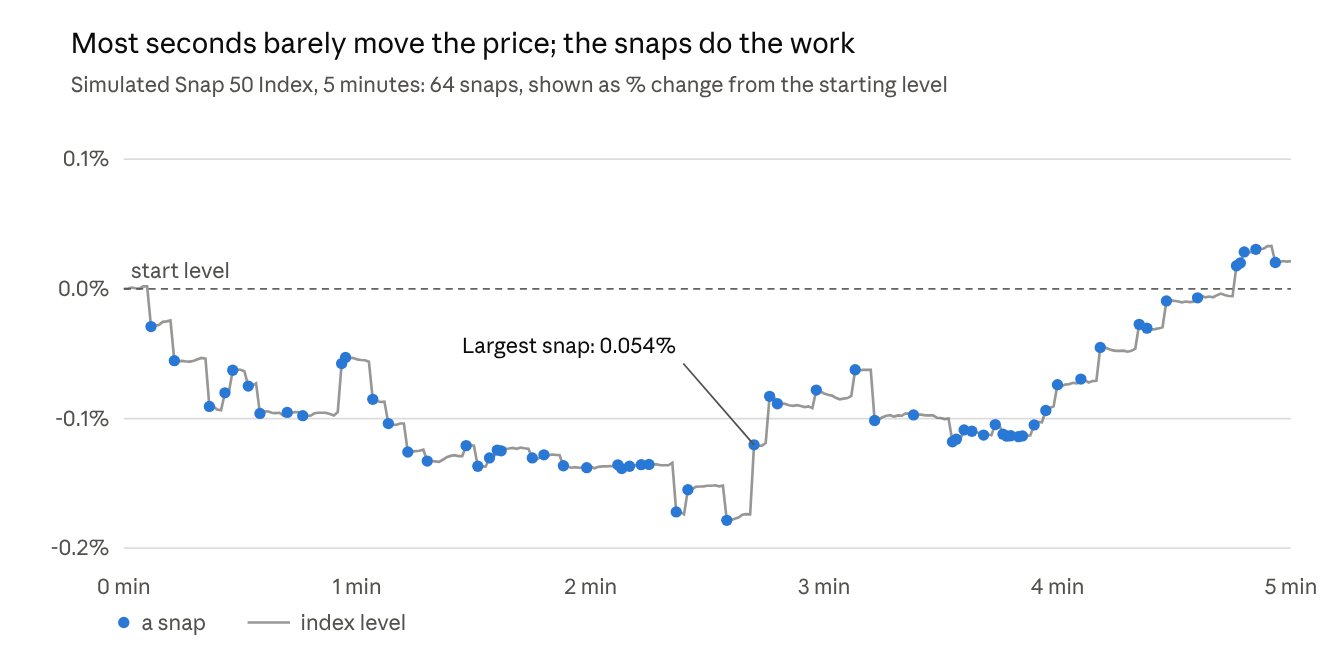
Simulated with the Snap 50 specification (5% noise volatility, snaps every 4.5 seconds on average, never more than 10 apart); illustration only
Between snaps the price hardly moves, so the chart shows a quiet line broken by steps. Each step is a snap, and the longer the quiet spell before it, the bigger the step tends to be.
Where the volatility comes from
The name of each index is its total annualised volatility. We allocate that budget in two parts:
| Snap 50 Index | Snap 80 Index | |
| Total annualised volatility | 50% | 80% |
| Background noise volatility | 5% | 8% |
| Share of variance carried by snaps | about 99% | about 99% |
| Average wait between snaps | about 4.5 ticks | about 4.5 ticks |
| Maximum wait | 10 ticks | 10 ticks |
| Typical snap (at the average wait) | about 0.014% | about 0.022% |
Snap size is set so that the noise and the snaps together add up to the number in the name. In a simulation of two million ticks, realised volatility came out at 50.09% and 80.14% against the 50% and 80% targets..
How Snap Indices differ from other Synthetic Indices
- Versus Volatility indices: the same overall volatility, delivered in a completely different shape. Almost all of it arrives in the snaps rather than in smooth continuous movement, so the chart has a punctuated texture instead of a steady drizzle.
- Versus Jump indices: snaps arrive every few seconds rather than a few times an hour, their size is tied to the wait before them, and one is guaranteed within 10 ticks.
- Versus Crash/Boom: there is no one-directional drift and opposite-direction spike. The background is low-level noise, and snaps go either way with equal probability.
Two versions, one design
Snap 50 and Snap 80 share one design at two intensities: Snap 50 has the lower volatility and Snap 80 the higher. The rhythm of small moves and snaps is the same on both.
Key facts
- Symbols: Snap 50 Index and Snap 80 Index
- Tick frequency: 1 tick per second, 24/7
- Availability: Deriv MT5 only for now
This content is not intended for EU residents.