
When One Stock Is a Whole Theme: Nvidia and the Capex It Rides On
Nvidia's valuation is a leveraged bet on hyperscaler AI spending. Here's why the same force that powered the rise is the one to watch for the break.
By the Deriv desk · 26 June 2026 · 4 min read

Nvidia's valuation is not really a bet on Nvidia. It is a bet on whether a handful of tech giants keep spending trillions on AI. Own the stock and you are long that spending, however the chips perform.
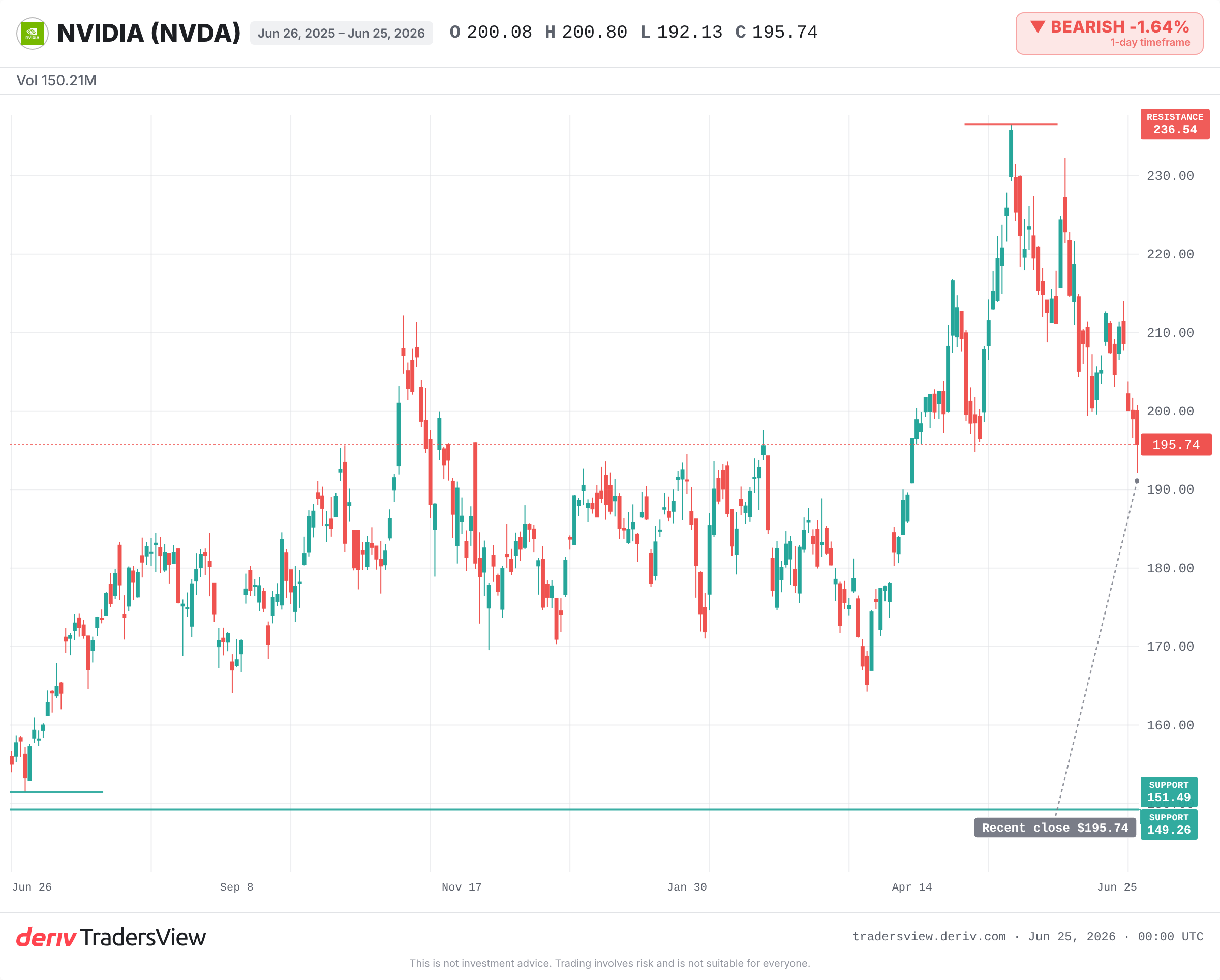
Nvidia is the most valuable company on earth. Its rise was built on one force: an unprecedented surge in data-centre spending. Revenue jumped 85% in its most recent quarter. Next-quarter guidance points higher still. The product thesis is clearly working.
Why Nvidia's price tracks hyperscaler capex, not chip demand
A small group of buyers fuels almost all of this. Microsoft, Alphabet, Amazon and Meta set the data-centre budgets that become Nvidia's order book. When they plan to spend more, Nvidia's pipeline fills. When they pause, it empties.
That concentration is the whole story. The same force that powered the climb is the one to watch for the break. Nvidia is a leveraged bet on whether promised AI infrastructure spending actually gets spent.
The pick-and-shovel trap: a winning product can still own a losing stock
This pattern has played out before. In 1999, Cisco became the world's most valuable company by selling the gear for the internet build-out. The internet kept growing. The capex that funded Cisco did not.

When telecom and dot-com spending collapsed, Cisco's stock fell about 80%. It took two decades to reclaim its peak. The product thesis was right. The valuation, built on spending that proved temporary, was wrong.
Nvidia has its own warning from 2018. Crypto miners were a concentrated buyer base. When crypto prices fell and miners stopped buying, the shares fell roughly 50% in months. A single demand driver can reverse fast.
Is Nvidia in a bubble? Why the multiple alone won't tell you
On valuation, the bull case holds up. Nvidia trades at about 23.5x forward earnings, barely above the S&P 500's 22x. If the earnings are real, the stock is not obviously expensive.
The risk is not today's price. It is what sits underneath the earnings. Those profits depend on buyers sustaining trillions in spending whose payback is still unproven. If the return on AI never shows up, budgets get cut, and the revenue that justifies the multiple goes with them.
Warning signs that a single-force rally is breaking
The tells to watch are about the spenders, not the chip:
- Capex guidance cuts. Any major hyperscaler trimming 2027 data-centre spending hits the demand thesis directly.
- Circular financing. Nvidia funding the customers who then buy its chips. Nortel and Lucent did this before the telecom glut, and it ended badly.
- Idle hardware. Signs of stockpiled, under-used GPUs would suggest buyers over-ordered.
- Custom silicon. Google's TPU, Amazon's Trainium and AMD eroding Nvidia's pricing power.
The evidence leans bullish while the spending holds. But the thing to track is not Nvidia's chip. It is the budget meetings at four other companies. The day one of them blinks, the leverage cuts the other way.
Frequently asked questions
A small group of hyperscalers, mainly Microsoft, Alphabet, Amazon and Meta, set the data-centre budgets that drive most of Nvidia's data-centre revenue. That concentration means a few spending decisions matter enormously.
It's when a supplier invests in or lends to the customers who then buy its products, effectively funding its own demand. It flattered telecom suppliers like Nortel and Lucent before the early-2000s glut, which is why it's a red flag worth tracking.
Both became the world's most valuable company by supplying the gear for a tech boom. Cisco's product stayed relevant, but its stock fell roughly 80% when the spending that funded its valuation collapsed. The parallel is about capex dependence, not a price prediction.
Possibly. Google's TPU, Amazon's Trainium and AMD's accelerators give big buyers alternatives. If hyperscalers shift more workloads to in-house silicon, it could erode Nvidia's pricing power over time.